Seabirds Between Worlds
Atlantic Puffins
Description
Are the smallest of the four puffin species. Compared to other seabirds, it is Medium sized with a short neck, and oversized bright orange beak. The bill grows larger and has more grooves as the bird ages. The bird stands upright on land and sites upright on the water. Puffins continually flap their wings when flying, but underwater their wings become powerful flippers, helping them to fly underwater to catch fast moving fish. 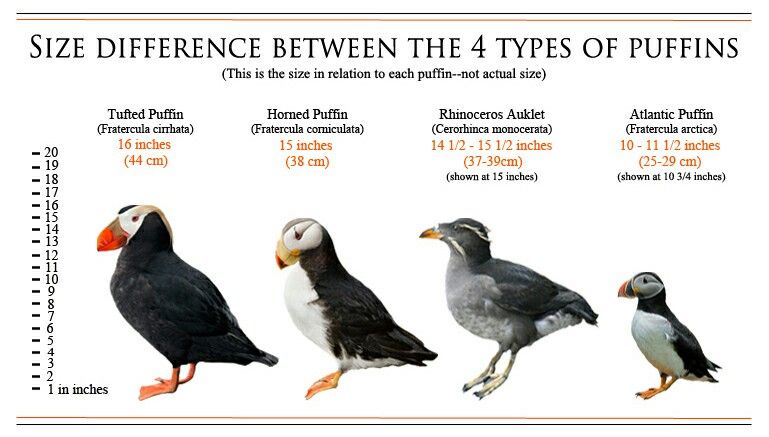
Their plumage and bill color changes between breeding and non-breeding seasons.
The Beak
Their brightly colored bills have earned them the nickname clowns of the sea. A puffin beak is designed with a layer of spines called denticles and a rough tongue to catch and hold on to small slippery fish. On average a puffin can hold 10-20 fish, but the record of a puffin in Britain was 62 fish at once.
Cool Fact: A puffin beak can glow! Scientists discovered the yellow strips in their beaks glow under UV light. While scientists are not 100% sure about the exact reasoning, they think it has something to do with selecting a mate as birds can see ultraviolet wavelengths. 
Stats: Both Sexes
Length: 10.2-11.4 inches
Weight: 10.9-19.4 oz
Wingspan: 20.9 inches
Lifespan: average 30 years. The oldest Atlantic Puffin in human care lived to 36 years old.
Range & Habitat
Late April through August mature puffins come ashore across the Northern Atlantic to nest. They nest in burrows on rocky islands with short vegetation, or on sea cliffs. In North America, the largest breeding population is in Newfoundland, Canada. Across the Atlantic, the Westman Island of Iceland is home to approximately 60% of the global population of Atlantic Puffins. During non-nesting season, puffins spend their time at sea. Not much is known about their lives at sea. Scientists are beginning to track puffins during this off-shore time to determine where they go, who they go with, and if they mix with other nesting populations while at sea.
Click the links below for research articles on Atlantic Puffin migration patterns
https://www.researchgate.net/publication/365346622_Overwinter_Movement_of_Atlantic_Puffins_Fratercula_arctica_Breeding_in_the_Gulf_of_Maine_Inter-_and_Intra-Colony_Effects
https://pmc.ncbi.nlm.nih.gov/articles/PMC8162707/
Breeding & Nesting
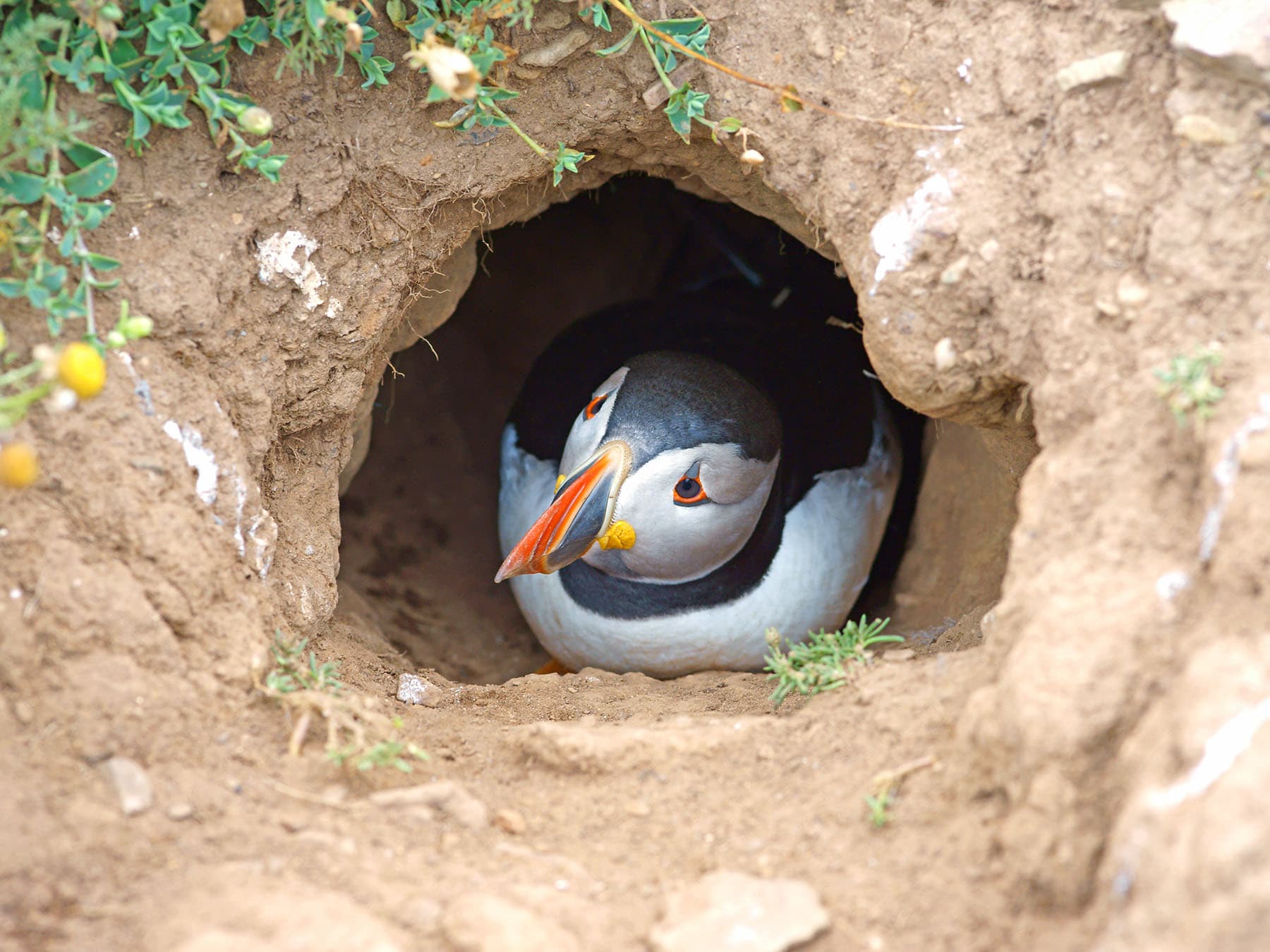
Atlantic Puffins start breeding between the ages of 3-6 years old. They typically find a mate and stay with that partner for life. They prefer to nest in colonies on small islands covered in short vegetation, typically in the turf soil at the tops of steep rocky cliffs. In some colonies in the north of the puffin's range, nests are placed in crevices or beneath boulders.
Atlantic puffins dig a shallow hole or burrow into the ground with their bill and feet. Both sexes share the task, with the male typically doing more excavation than the female. Pieces of grass and twigs are placed to line the bottom of the burrow. The Pair tend to reuse the same burrow year after year.
Nesting Stats
Clutch Size: 1 egg
Number of Broods: 1 brood
Egg Length: 2.3-2.6 inches
Egg Width: 1.7-1.9 inches
Incubation Period: 36-45 days
Nesting Period: 38-44 days
If their first egg is lost (predation) or damaged and it's very early on in the nesting season, the female may attempt to lay a second egg. This is not always the case as it takes a great deal of energy to produce the egg, and laying a second egg shortens the time the adults have to raise (fatten up) the puffling before it needs to fledge the nest.
Cool Fact: Puffin babies are known as pufflings
Diet

Atlantic Puffins eat small fish around 2-6 inches long, mainly sandlance, sprat, capelin, herring, hake, and cod. During the breeding season, they forage in shallow waters close to the breeding colony, generally not straying more than 10 miles from shore. Atlantic Puffins often capture several fish in a single dive, holding them crosswise in their bill. During hunting dives, they can hold their breath for up to 30 seconds, so being a able to catch lots of fish in a short amount of time is very important.
Puffin parents bring back these small, faffy, nutritious fish to feed through young pufflings, helping them to grow quickly before fledging the nest at 6 weeks old. changing ocean temperatures are shifting ideal prey populations, make it challenging for puffins to find fish with nutrition their pufflings need to grow. They often bring back less nutritious fish or fish that are too big for their pufflings to eat. This has resulted in a decrease in fledgeling success rates.
Scientists are studying food sources puffins are bringing to their young through nest cam footage and guano sampling.
Click below for an article and research paper on Atlantic Puffin diets.
https://www.audubon.org/news/what-baby-puffins-diet-tells-us-about-its-future
https://www.facetsjournal.com/article/facets-2015-0009/
Behavior
Atlantic Puffins spend most of their life on the open ocean, coming ashore only to breed. On land they waddle like a penguin, teetering slightly from side to side. They "fly" underwater using their wings for propulsion and their feet as a rudder. They can dive to depths of around 200 feet, but they typically feed in shallower waters. During the breeding season, they forage in small groups of up to around 7; in the winter they are less social often foraging singly or with another individual. At the breeding colonies they are social birds, often placing their nesting borrows within a couple of body lengths of each other. Birds arriving to the colony often crouch in a horizontal position with one foot in front of the other as if bowing to accepted to the group. They also walk around the colony in a horizontal position to signal nonaggression. Atlantic Puffins form monogamous bonds and often return to the same burrow with the same mate in subsequent years. To attract a female, males flick their heads and grunt like a pig near a nesting burrow. Once paired, they maintain their bond by rubbing their bills together, in a behavior known as billing. Individuals often shake their head side to side or stomp their feet to proclaim burrow ownership. Intruding males that get too close to the nesting burrow are met with ruffled feathers and an open bill. Occasionally a fight ensures with clawing and grappling. Nonbreeders at the colony often form flocks and spend hours flying in a wide circular or figure-8 pattern over the colony cliffs, a behavior called wheeling flight.
Predators
With the unique lifestyle, Atlantic puffins have ariel, land, and marine predators. Ariel predators are large birds of prey: snowy owls, bald eagles, ravens, black-back gulls, and great skuas. These avian predators are known to prey on adult puffins and dig through burrows for eggs. Land predators consist of mammals like foxes, and introduced mammalian species like mink, weasels, cats, and rats. Puffins try to select islands with limited land predators for their nesting sites. While less common, they do have a few marine predators like grey seals and large fish, like anglerfish.
Conservation
Atlantic Puffins number in the millions, but their numbers are declining mainly due to changes in their food supplies from warning ocean waters. At present in North America, the species rates an 8 out of 20 on the Continental Concern Score, which means it is not on the Partners in Flight Watch List and is a species of low conservation concern. The North American Waterbird Conservation Plan estimates between 750,000 to 760,000 breeding birds on the continent while the global breeding population is estimated at 12 million according to Partners in Flight. The species is ranked as Vulnerable on the UUCN Red List. About half of all Atlantic Puffins breed in Iceland. In the southern half of the country, warming ocean waters have changed the availability of sandlance, causing almost complete breeding failure each year for more than a decade. The decrease in food has also lead to puffin deaths during overwintering storms while out at sea. In January of 2026, estimates of over 20,000 dead puffins washed ashore in France. Puffins used to breed on Iceland's mainland, but after American mink escaped and spread across the country in the 1930s, almost all the mainland colonies were eradicated. Most of Iceland's remaining puffin colonies are on small islands just offshore. In Iceland and the Faroe Islands, the birds have been hunted relatively sustainably for centuries. But in North America, heavy exploitation for eggs, meat, and feathers in the 1800s and early 1900s caused populations to decline, and puffins disappeared entirely from the United States. Thanks to the creation of protection area and the groundbreaking work to translocate young pufflings to nesting island by Steve Kress of the National Audubon Society, more than 2,000 puffins now breed again in Maine.
Click here for articles on Puffin storm deaths: https://phys.org/news/2026-03-thousands-dead-puffins-europe-beaches.html
Click Here for information about Project Puffin: https://www.audubon.org/seabird-institute/projects/project-puffin-seabird-stewardship-along-maines-coast
Project Puffin Key Timeline Dates
- 1973: Project begins. Initial translocation of puffin chicks from Newfoundland to Eastern Egg Rock.
- 1973-1986: 954 puffin chicks translocated to Eastern Egg Rock
- 1980: Terns return to nest on Eastern Egg Rock, indicating a safe habitat.
- 1981: First successful puffin breeding (one pair) of Eastern Egg Rock.
- 1984-1989: 950 puffin chicks introduced to Seal Island National Wildlife Refuge
- 1990s: Puffin population begins to grow significantly, establishing a viable colony
- 2008: Record numbers of nesting pairs are reported.
- 2011-2012: Over 100 pairs nest of Egg Rock and 500+ on Seal Island
- 2023: Project Puffin marks 50 years, with techniques applied at over 500 sites globally.
Puffins are loved and celebrated throughout the North Atlantic. They appear in folklore tales and are the center of ecotourism supporting coastal communities.
United States: More than 4,000 visitors support Maine's coastal communities annually, flocking to catch a glimpse of the puffin and seabird conservation work along the coastline.
Newfoundland: Puffins were voted to the the province's official bird and appear on their currency. The largest breeding population in North America, an estimated 260,000 paires nest in Witless Bay Ecological Reserves, creating a major hotspot for eco-tourism.
Ireland: Indigenous gales considered puffins to be guardians of the sea and storm indicators, connected to Manannan Mac Lir, the sea-god and lord of the Isle of Man in Gaelic mythology. If puffins came close to shore, it was an indicator of bad weather and wet days ahead. Their white and black cloak like appearance also gave them the resemblance of monks. Some even thought their borrows were portals to other-worlds.
Puffin Rock is an Irish award-winning animated preschool series, featuring a young puffin and her brother exploring wildlife and nature along their cliffside island. The series was transformed into an exploratory art exhibition designed to inspire young children to explore, learn, and protect natural habitats.
Iceland: Has the largest nesting population of Atlantic Puffins. There are puffin statues and street signs dedicated to these wonderful birds. Each nesting season children go on puffin patrol. They monitor the streets at dusk for lost pufflings, gathering them up, and bringing them back to the cliff side. The children then toss the puffins into the water so they can start their lives on the open sea.
Norway: Historically hunted for their meat and eggs, their populations dwindled. They country developed a special breed of dog (Lundehund) to hunt puffins. The dog has six toes and is extremely flexible, allowing it to maneuver steep cliffside and rocky terrain. The country turned to celebrating the birds and to shift people's attitudes towards conservation. Since 1996 on April 14th there is a festival celebrating the return of puffins to nest. This is considered the start of spring.
Scotland: Puffins are referred to as Tammie Norries or Tommies, an old Scots term for a foolish looking man, for how puffins look when moving on land. This term comes from Shetland and Orkney dialect with one of the earliest references recorded in 1701.
Maritime Puffins
3 Males from Omaha's Henry Doorly Zoo
- 7/6/2016 - Valentine - grey band
- 6/18/2023 - Bean - gold band
- 4/16/2024 - Beetle - orange band
3 Females from Sea World San Diego
- 7/8/2013 - black band
- 7/10/2015 - red band
- 6/18/2016 - yellow band
Common Murre
Description
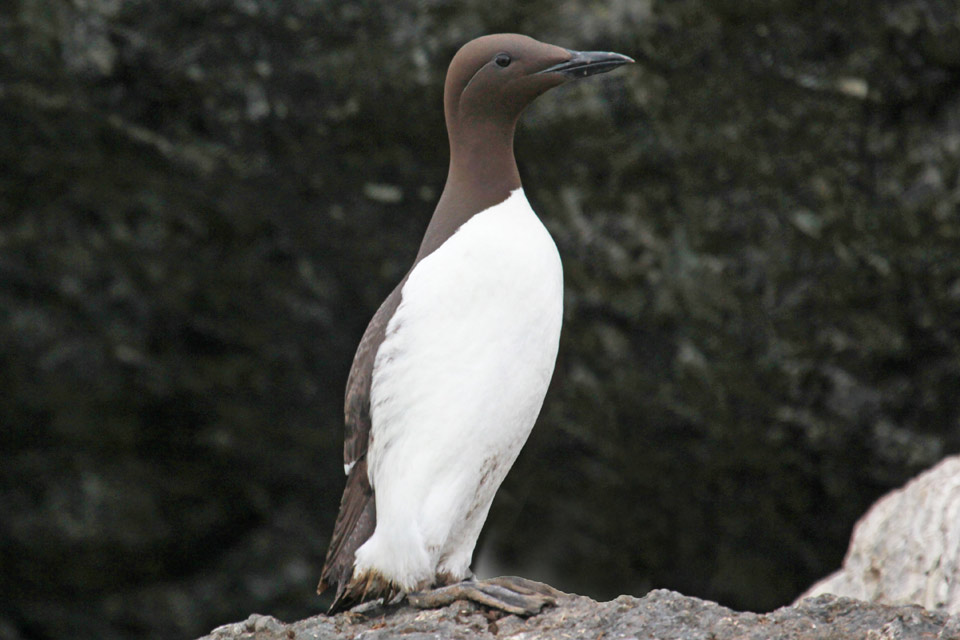
A large, heavy bodied seabird, similar in shape to a loon (but smaller and shorter necked). Often described as a "flying penguin", they have a tuxedoed look, but are shorter related to auks and puffins. These birds have a long pointed bill, short tails, and short wings that propel them through the water, similar to how penguins swim, diving to great depths to catch fish. Unlike penguins, their wings allow them to also fly through the air.
Breeding murres are identified with a blackish head, face and upper body and a white underside. Non-breeding birds have a pale throat and face with a dark line behind the eyes. Some Atlantic adults in breeding plumage have a "brindle" appearance: a white eyering with white line extending behind it.
The Beak
Murres use their tongue and beak to trap and hold onto fish and their other prey items, similar to puffins. Their tongue has rough edges and the top of the beak has denticles for holding the fish until they return to land.
Measurements (Both Sexes)
Length: 15.0-16.9 inches
Weight: 28.2 - 39.7 oz
Wingspan: 25.2 - 27.9 inches
Average Lifespan: 25 years. The oldest Common Murre in human care lived to be 34 at Oregon Coast Aquarium.
Cool Fact: The oldest Murre on record lived to be 44 years old in Sweden.
Regional Differences Between Species
Worldwide, five subspecies are described, three of which occur in North America. Pacific-nesting subspecies include californica, which breeds from California to southern British Columbia; and inornata which breeds from northern British Columbia to Alaska and eastern Asia. In the Atlantic, the smaller aalge breeds in northeastern North America to east to Russia. The other subspecies are albionis in the western Europe and United Kingdom, and hyperborea in Norway. It's through that the very different Atlantic and Pacific groups have been separated from one another since the Pleistocene.
Range
Found in Northern ocean waters in the Atlantic and Pacific. They are pelagic species that comes ashore during breeding season. They can be seen from California to Alaska on the west coast of the United States, and New Jersey northward on the east coast of the United States.
Habitat
Common Murres nest on rocky cliffs and headlands at the edge of the ocean. During breeding season, they forage at sea, normally over waters deeper than 100 feet and well away from land, and places where warm and cool currents meet and concentrate their prey, mostly fish and sometimes other species with squid and crustaceans. They hunt close to shore, even during the nonbreeding season, but will not come ashore to rest, they will remain on the ocean.
Diet
Common Murres mostly hunt for fish and will occasionally eat squid and octopus. During the non-breeding season they may hunt for crustaceans such as krill and amphipods. In the Pacific, they will hunt for rockfish, pollock, a variety of cod, perch, sandlance, sculpin, hake, capelin, herring, smelt, and sardines. In the Atlantic they hunt for capelin, sandlance, shad, flounder, and Atlantic cod. They can hunt alone or in flocks, or often with other species of seabirds. Using their short, narrow wings for propulsion and steering, they can dive to depts of 500 ft (591 ft have been recorded). Unlike some other species of seabirds, common murres prefer to eat their prey underwater, expect when bringing it back to feed their young. During these hunting dives they can hold their breath and stay underwater for up to 3 minutes.
Breeding & Nesting
Murres pairs do not make a nest. Instead they lay their single egg directly on a cliff ledge or similar site above the ocean, sometimes in a hidden crevice. They may arrange small pebbles around the egg , and use their guano to "cement" the egg in place, helping protect it from falling off the cliff.

Nesting Facts
Clutch Size: 1 egg
Number of Broods: 1 brood
Incubation Period: 26-39 Days
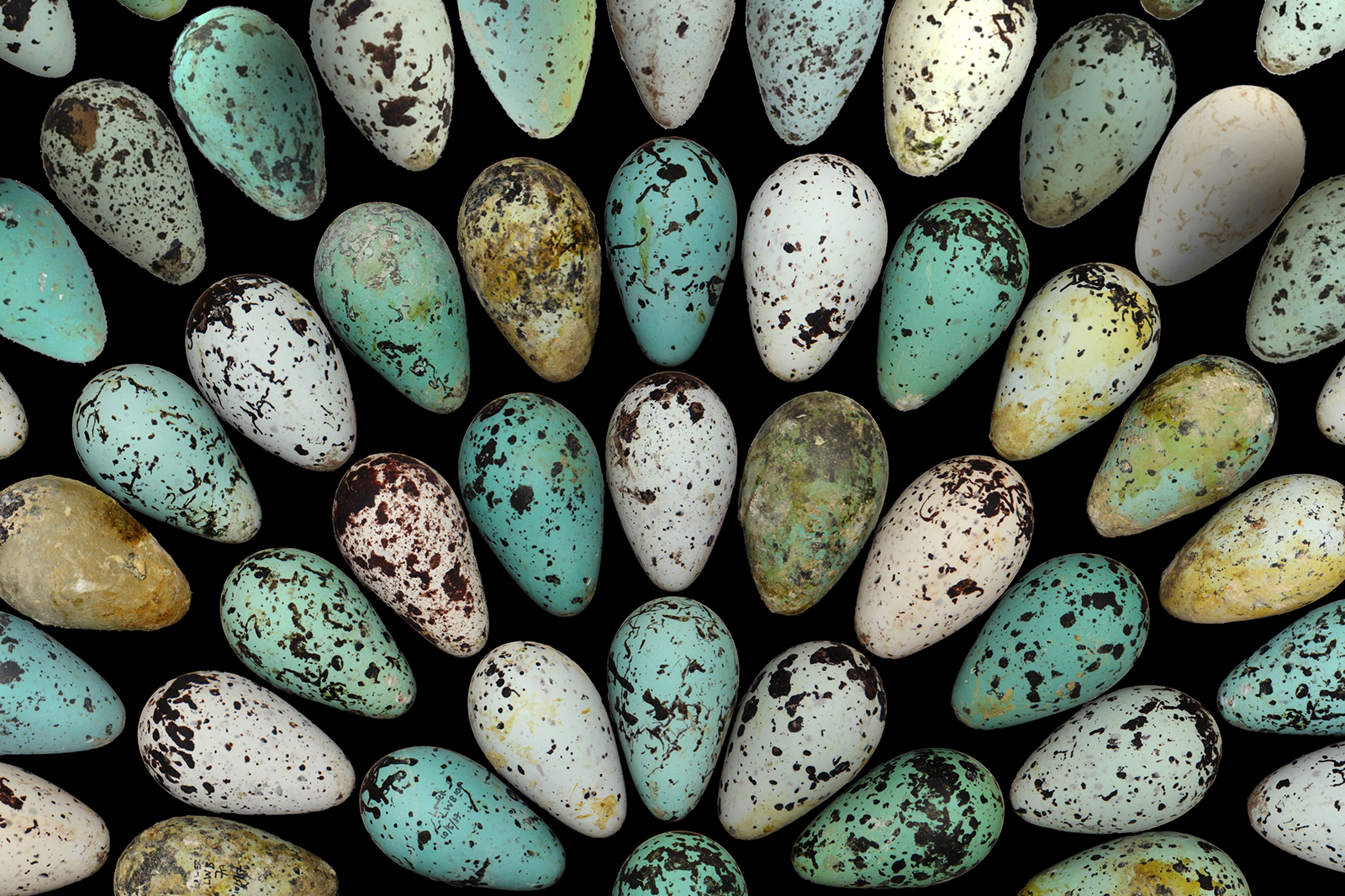
Egg Description: Very pointed at one end. Color variable, ranging from white to tan without markings, to dark green or turquoise with extensive black spots or scrawls.
If the first egg is lost (predation) or damaged and it's early in the nesting season, the female may attempt to lay a second egg. The female can produce a second egg in about 14 days, but it'll be about 5% smaller than the original egg. If the second egg is lost, the pair will not lay again until the next nesting season.
Cool Fact: A female murre will lay identical eggs for her entire life. Each breeding season, her egg will be the same color with similar markings to her egg from previous seasons.
Click here for a research article on Common Murre eggs: https://academic.oup.com/auk/article/138/4/ukab049/6356082?guestAccessKey=
Cool Fact: The shape of a murre egg is distinctive: narrow, almost pointed at one end, very broad and round at the other. If nudged accidently, these eggs roll in a neat circle around the narrow end, decreasing their odds of rolling off the cliffside.
When the baby murre hatches, it's covered in down feathers and able to stand within a day. At three week's old the baby murre will fledge the cliff. Often called jumplings, they will enter the water before they can fly and spend the next several months out at sea with their fathers. learning how to hunt and survive. When the fledgings learn to fly they will become fully independent from their parents.
Behavior
Common Murre are monogamous and often stay partnered for several years. Before nesting, groups of murres can display behaviors such as "water dancing" chasing each other, pattering over the water but not flying, or taking "joy flights" meaning they fly in circles. To establish and maintain a bond, murres using a greeting ritual, which includes sparring with their bills, bowing, and preening one another.
Males guard females intensely before egg-laying, chasing off rivals with sudden lunges and bill jabs. Although murres do not have true territories, they defend the immediate area where the egg and chicks are present. Paris use the same precise sites for nesting each year, and young murres usually return to the same cliff where they were hatched. both parents feed the single chick. The male takes the chick to sea and teaches it how to hunt and survive on the open ocean.
Predators
With the unique lifestyle, Common murre have ariel, land, and marine predators. Ariel predators are large birds of prey like eagles and gulls. Eagles will fly by colonies and cause a large disturbance, causing the murres to abandon their eggs, allowing gulls to come in and prey on the unprotected eggs. Falcons have also been known to prey upon adult murres and chicks. Land predators consist of mammals like foxes, and introduced mammalian species cats, and rats that prey upon the eggs and baby chicks. Their marine predators consist of grey seals on the Atlantic side, California sea lions on the Pacific, and sharks on both sides.
Conservation
In North America, Pacific populations of Common Murre have declined in recent decades, but Atlantic populations appear to be increasing slightly in some areas. Partners in Flight estimates the global breeding population in 12 million individuals, with about 7.4 million breeding in the United States and Canada. The group rates the species an 11 out of 20 on the Continental Concern Score, indicated a relatively low level of conservation concern. Despite the current large population, global climate change is forecast to modify ocean temperatures and currents and alter the availability of preferred prey species. These changes could have significant effects on murres and other seabirds. Murres are vulnerable to pollution from oil spills, entanglement, and introduction of new predators to their nesting locations. Murres are still hunted as a food source with around 100,000 taken annually in Canada through regulated hunting, as well as Greenland and the Faeroe Islands.
Maritime Common Murres
3 males from Sea World San Diego
- 6/11/2000 - blue band
- 7/21/2019 - teal band
- 7/27/2020 - brown band
- 9/14/1994 - purple band
- 12/11/1996 - pink band
- 8/6/2024 - green band
Exhibit Interpretation
Big Idea: Seabirds are connectors, linking land and ocean ecosystems, cultures and actions across the Atlantic, and humans to the ocean.
Exhibit Objectives - Guests will:
Experience
- Watching seabirds in a large naturalistic habitat
- Exploring an immersive coastal environment, discovering how puffins and murres live and interact on land.
- Seabirds and other animals rely on healthy ocean habitats
- These birds and humans rely on a healthy ocean habitat
- The connection between humans and these birds through learning about climate impacts, folklore stories, and more.
- Optimistic and inspired about the future of seabird conservation work.
- Explore the puffin rock diorama
- Engage in a hands-on activity with a facilitator
- Listen to a seabird talk
- Download of take a Seafood Watch Card
Elements:
- Live seabirds with feeding demonstrations
- Live interpretation (gallery walks & informal talks)
- Immersive seabird rock to explore the onshore life of seabirds
- Connecting seabirds and culture
Storylines
- Seabird life
- Communities, Breeding/Nesting, Behavior/interactions, Diet
- Climate Change
- Warming ocean temperature impacts on prey sources for adults and chicks
- Conservation
- Project puffin past, present, and future. What can actions can guests take, and conservation in culture
- Culture
- How are seabirds viewed through history and present day, celebrated, and preserved around the world
Habitat Specs
- 7,000 Gallons of Water
- Water depth is 5 ft.
- Water Temp: 50 Degress F
- Air Temp: 50 Degrees F
- Lighting: Circadian rhythm to follow sunrise and sunset with the seasons
- Filtration: 2 sand filters that filter 175 gallons/minute. The habitat cycles every 40 minutes.